
Divorce is a sensitive decision, and it should not be treated as a single simple procedure or a fixed template that applies to everyone. In reality, Divorce in Saudi Arabiamay involve documenting a divorce that has already occurred, or it may take the form of khul’ based on agreement and consideration, or it may develop into a court case involving annulment, alimony, child custody, or enforcement of judgments related to children. For this reason, many people make a mistake when they search for “how to get divorced” as though it were only one path.
This guide explains the current legal framework, outlines the most searched types of divorce, and details the practical procedures between documenting a divorce through Najiz and filing a statement of claim before the Personal Status Court. It also explains matters relating to the divorce deed, post-separation rights, and when obtaining specialized legal advice becomes important rather than merely optional.
Do you need help understanding the most suitable procedure for your case? Contact us through the WhatsApp button below to be connected with a divorce lawyer specialized in Saudi cases.
جدول المحتويات
What is meant by divorce under the Saudi legal system? Definition and legal distinction
In its legal meaning, divorce is the dissolution of the marriage contract by the husband’s will, expressed in words indicating divorce. This is the legal starting point that must be understood before any further detail. The law distinguishes between divorce as a termination of the marital bond on one hand, and other forms of separation such as khul’ and annulment on the other. It also establishes that divorce is not all of one degree; rather, it may be revocable or irrevocable, and the consequences of each type differ in terms of reconciliation, the waiting period, and post-separation effects.
The difference between divorce, khul’, and annulment of marriage
The law sets clear boundaries between the different forms of separation based on intent, financial consideration, and legal effect:
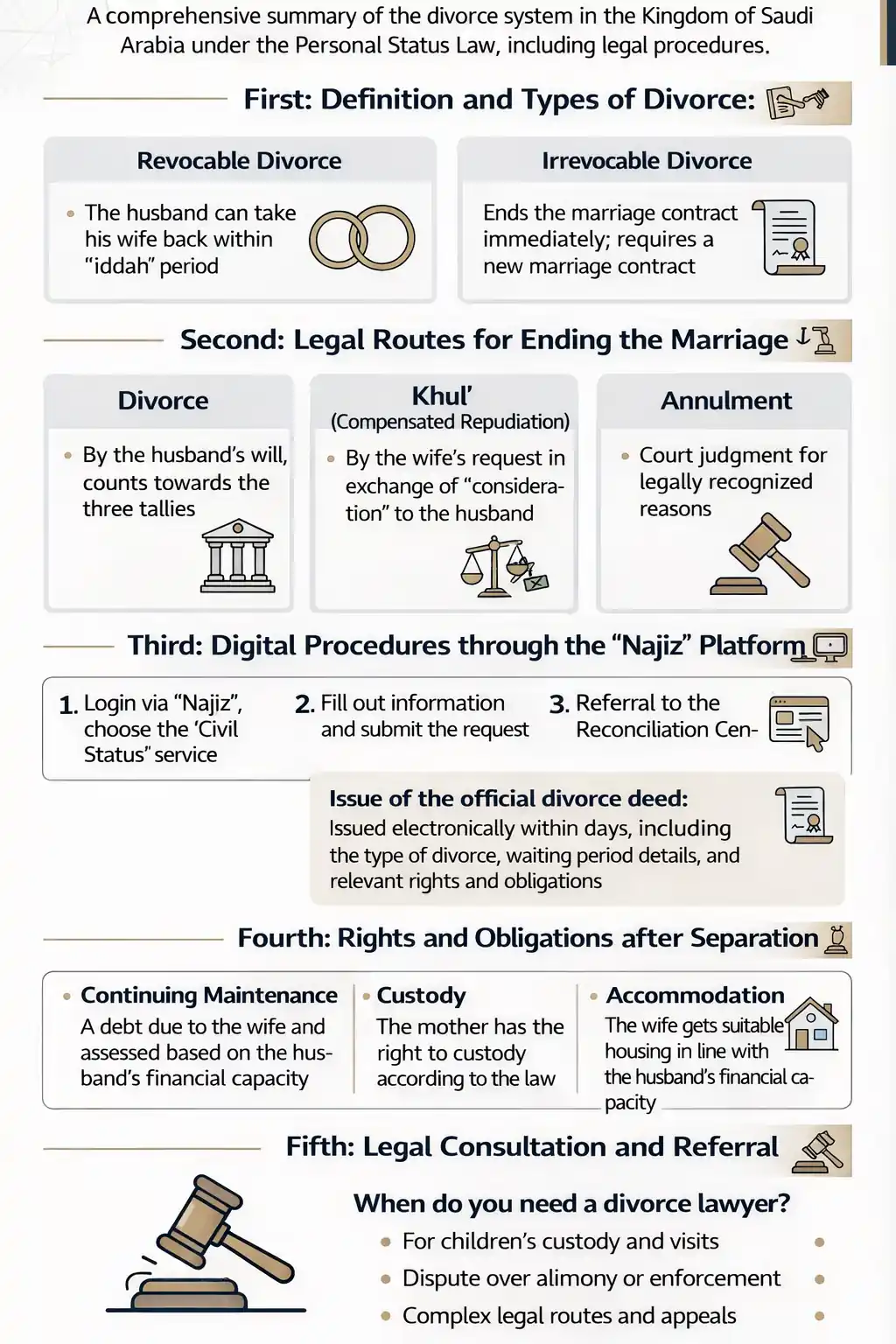
- Divorce (the husband’s will): This is the termination of the marital bond by explicit words or implied words used by the husband. In this case, the husband remains responsible for all financial consequences, including the deferred dowry, waiting-period maintenance, and mut’ah maintenance in certain cases. Divorce counts toward the total of three divorces.
- Khul’ (mutual agreement in exchange for consideration): Article 95 defines it as a separation between spouses at the wife’s request and with the husband’s consent, in exchange for “consideration” provided by the wife.
- Annulment of marriage (judicial ruling): This is the termination of the marriage contract by judicial decision based on legal grounds such as defects, harm, or failure to provide maintenance. Annulment ends the marriage irrevocably as a minor separation and does not count as one of the three divorces under Article 103.
Legislative reference: the new Personal Status Law
The primary reference today for divorce in Saudi Arabia is the Personal Status Law issued by Royal Decree No. (M/73) and officially published in the Official Gazette. This was followed by the Implementing Regulations of the Personal Status Law, published on 21 February 2025, which further detailed a number of relevant procedural and regulatory provisions.
The role of the Personal Status Courts
The Personal Status Courts are the judicial authority competent to hear matters relating to divorce, khul’, annulment of marriage, reconciliation, custody, maintenance, and visitation.
Types of divorce in Saudi Arabia
The Personal Status Law classifies divorce into only two categories: revocable divorce and irrevocable divorce. However, other forms branch from these, such as divorce by mutual agreement, divorce in absentia, divorce for harm, and innovative divorce. These are discussed in the following sections.
Revocable divorce and irrevocable divorce
Under the Personal Status Law:
- Revocable divorce: This occurs after consummation and does not immediately terminate the marriage contract. The husband has the right to take his wife back as long as she is still within the ‘iddah (waiting period), under Article 87.
- Irrevocable divorce: This terminates the marriage contract once it occurs, and it is divided into:
- Minor irrevocable divorce: This immediately ends the marriage, such as divorce before consummation, khul’, or annulment. The husband cannot remarry his wife except through a new marriage contract and a new dowry, and only with her full consent.
- Major irrevocable divorce: This is the third and final divorce. In this case, the woman becomes completely unlawful for her former husband and cannot return to him unless she lawfully marries another man in a genuine marriage, not a marriage of convenience, and the marriage is consummated, under Article 85.
Divorce by mutual agreement
The term divorce by mutual agreement is very common, but in practice it describes a state of agreement more than it does an independent legal classification. It means that the spouses agree on the separation itself, and often also on some of the related effects such as arrangements for the children, maintenance, or housing, and then complete the legal process through documentation or a formally recorded agreement.
When both parties succeed in reaching a clear settlement, the path is usually faster and less confrontational than lengthy litigation, especially if the settlement agreement can be formally recorded and turned into an enforceable instrument when needed.
Khul’ in Saudi Arabia
Khul’ is a form of separation in exchange for consideration. For this reason, the law states that if khul’ takes place without consideration, it is not regarded as khul’; instead, the rules of divorce apply to it. The law also provides that khul’ does not count as one of the three divorces, and that it may occur regardless of the wife’s condition, including during menstruation.
In practical terms, khul’ is suitable in cases where the wife wishes to end the marriage and there is room to agree on the consideration, or where this is established before the competent authority.
Divorce for harm
Divorce for harm is a judicial separation between spouses ordered by the court when substantial harm to one of the parties is proven and makes continuation of the marriage impossible.
When does a judge grant divorce for harm?
A request for judicial separation on the basis of harm is considered when the court is satisfied that one of the following has occurred, for example:
- mistreatment or abuse;
- refusal to provide maintenance;
- prolonged abandonment without justification;
- absence or disappearance;
- psychological or physical harm;
- impossibility of continuing marital life;
- ongoing discord between the spouses.
In such cases, the court may first attempt reconciliation, and it may appoint two arbitrators to review the dispute before ordering the separation.
Divorce in absentia
Divorce in absentia in Saudi Arabia refers to a divorce that takes place without the wife’s presence or without her knowledge that the divorce has occurred, whether the husband pronounces it unilaterally and then fails to inform her, or a court issues a judgment of separation without one party being present after completion of the required legal procedures.
Menstruation-related divorce and innovative divorce
Divorce during menstruation is one of the issues most frequently asked about when discussing innovative divorce, because Saudi law expressly addresses this situation within the rules governing the validity of divorce.
- Divorce during menstruation: This is a divorce pronounced while the wife is menstruating, in postpartum bleeding, or in a period of purity during which the husband had intercourse with her. It is one of the forms of innovative divorce.
- Innovative divorce: This is a divorce pronounced contrary to the legal rules. The law specifies situations in which a divorce pronouncement is not recognized, in order to protect the family from impulsive reactions:
- Psychological condition: The divorce of an enraged person who has lost control over his words does not take effect, nor does the divorce of a coerced person or a person lacking mental capacity.
- Biological condition: Divorce does not take effect if the wife is menstruating, in postpartum bleeding, or in a period of purity during which the husband had intercourse with her while knowing her condition.
Divorce procedures in Saudi Arabia step by step
Divorce procedures in Saudi Arabia follow this sequence:
- Submit an application through the Najiz platform, whether for documenting a divorce or filing an annulment claim.
- Mandatory referral to the Reconciliation Center.
- If the parties agree, a settlement record is issued and becomes an enforceable instrument.
- If the parties disagree, the case is referred to the competent judicial circuit to issue a ruling.
It is worth noting that under Article 16/33 of the Implementing Regulations of the Law of Sharia Procedure, if there are children, referral to reconciliation becomes mandatory.
When is documenting a divorce sufficient?
Documenting a divorce in saudi arabia is the most appropriate path when the divorce has already taken place and the goal is to formally record it through the dedicated Ministry of Justice process.
The Divorce Documentation service on Najiz is designed to document a previous or recent divorce after completion of the required procedures and approvals, following which an official divorce document is issued. According to the Ministry of Justice, this service does not carry a direct service fee. In many consensual cases, or cases where the divorce itself is not disputed, this is the shortest practical route.
When do you need to file a statement of claim?
You need to file a statement of claim when the matter is not merely one of documentation, but of judicial dispute. This usually includes:
- disputed khul’ cases or annulment cases;
- disputes over maintenance, custody, or visitation;
- cases involving disagreement over the divorce itself, its type, or its legal effects.
The statement of claim service through Najiz is the gateway for filing a lawsuit before the competent court. It allows the registration of the parties, attachment of supporting documents, and commencement of the judicial process. The Ministry of Justice also explains that the case journey begins with filing the statement of claim and then following up the application through the platform.
How do you verify the validity of a divorce document?
If you want to confirm the validity of a divorce document or verify it electronically, the Ministry of Justice provides a separate service called Verification of Civil Status Document. The official steps begin with:
- logging in to Najiz;
- selecting All Electronic Services;
- choosing the Verification Services Package;
- accessing the service and entering the required verification data.
The Ministry of Justice also states that this service carries “divorce in saudi arabia” no direct service fee.
Are there fees for divorce in Saudi Arabia?
The divorce documentation service itself does not carry a direct service fee according to the official Ministry of Justice page, and the electronic statement of claim service also does not show a direct service fee on its access page.
However, attention should be paid to the fact that the Judicial Costs Law exempts the cases and applications within the jurisdiction of the Personal Status Courts from judicial costs, with important exceptions, most notably applications for appeal, cassation, and petitions for reconsideration.
Illustrative table of divorce fees in Saudi Arabia
| Situation | Most suitable route | Are there direct service fees? |
|---|---|---|
| The divorce in saudi arabia has already occurred and needs to be formally documented | Divorce documentation through Najiz | No direct service fee |
| There is a dispute over the divorce itself or the related rights | Statement of claim | No direct service fee for the portal itself |
| You want to verify the document electronically | Verification of civil status document | No direct service fee |
| You want to challenge the judgment | Appeal against the judgment | Fees apply depending on the application and level of appeal |
Divorce deed in Saudi Arabia
The divorce deed, also referred to as the final divorce document, is the official document proving the occurrence of the divorce after it has been formally approved. According to the Ministry of Justice’s official FAQs, the divorce document serves as a substitute for the divorce deed and can be viewed through Najiz.
What information does it usually contain?
The exact information varies according to the facts of the case and the electronic template used. The official documentation forms show that the information includes:
- the type of divorce in saudi arabia: revocable, minor irrevocable, or major irrevocable;
- the number of divorces, to determine the remaining count available to the spouses;
- the details of the waiting period, including its start date, end date, and type;
- related rights: the deed, especially when issued following settlement, often includes details of maintenance, custody, and visitation.
Rights after divorce in Saudi Arabia
The rights after divorce in saudi arabia are a matter of concern for many people, and the Saudi Personal Status Law addresses them by prioritizing the best interests of the child in custody over the wishes of the parents.
Wife’s maintenance after divorce
A divorced wife’s maintenance is a privileged debt that does not lapse except by payment or waiver. One of the most searched questions is: Is a divorced woman entitled to maintenance? The short answer is that it depends on the type of divorce and the factual circumstances. The law provides that maintenance is a right of the person entitled to support, and it includes food, clothing, housing, and essential needs in accordance with custom and the relevant rulings. It also provides that a woman in the waiting period following an irrevocable divorce is not entitled to maintenance unless she is pregnant, in which case her maintenance continues until she gives birth.
Children’s maintenance after divorce
As for children’s maintenance, it remains independent from the dispute between the spouses. The basic rule is that the father is responsible for it, subject to legal provisions that address situations such as his absence or insolvency. In all cases, the amount is not fixed, but depends on the specific circumstances, income, the children’s needs, and whatever the parties prove before the court.
Child custody after divorce
The current law settled a point that many people do not know: custody is one of the duties of both parents so long as the marriage exists, and if they separate, the custody goes first to the mother, then to the father, then to those who follow them according to the statutory order. However, the regulations added a number of important strategic details:
- The two-year rule (Article 33 of the Regulations): If the child is under two years of age, the mother’s right to custody does not lapse even if she marries a non-relative, in recognition of the infant’s strong need for the mother.
- Loss of custody (Article 128): Custody lapses if the condition of trustworthiness or capability is no longer met, or if the custodian moves to a place for residence in a way that undermines the child’s best interests.
- Custodian’s powers (Article 32 of the Regulations): The custodian now has the authority to complete the child’s government procedures through digital platforms, receive the child’s allowances, and retain the child’s records, which ends the difficulty of “educational guardianship” that previously constituted an obstacle.
Visitation, hosted visitation, and accompaniment
It is no longer acceptable for visitation to be limited to mere “viewing” in narrow public places. The law encourages accompanied visitation and overnight stays with the non-custodial parent to ensure sound upbringing, unless a risk to the child is proven. When regulating the taking and return of the child, the regulations take into account factors such as the child’s best interests, place of residence, and the circumstances of the parties to the dispute.
The Ministry of Justice also provides a Visitation Order Issuance service for enforcing judgments contained in an enforceable instrument, in addition to the Shaml Initiative, which provides a suitable environment for implementing custody, access, and visitation rulings in a way that protects family privacy and serves the child’s best interests.
The enforcement route (Enforcement Court)
After the deed or settlement record is issued, if the father refuses to pay maintenance or the mother prevents the father from visitation, the matter proceeds directly to the enforcement judge. Under the Enforcement Law, the judge may order:
- a travel ban;
- suspension of government services;
- attachment of bank accounts;
- and in custody and visitation cases, enforcement by compulsion or even criminal penalties against the non-compliant party.
The rights after divorce in saudi arabia are usually built upon the grounds for separation as determined by the judiciary.
Grounds for divorce in Saudi Arabia
Saudi courts classify the grounds for divorce in order to assess compensation or annulment. A strategic understanding of these grounds determines who pays whom. Among the main grounds that may justify annulment of marriage are:
- Failure to provide maintenance: If the husband’s insolvency or deliberate refusal is proven, the marriage may be annulled immediately because maintenance is one of the foundations of the contract.
- Defects and illnesses: The existence of defects preventing marital relations, or repellent illnesses that were not disclosed at the time of the marriage contract.
- Absence and disappearance: If the husband has been absent for no less than four months, the wife may request annulment.
- Harm and ill-treatment: This is the most common ground and requires legally admissible proof, such as witnesses, medical reports, or testimony by common reputation under Article 27 of the Regulations.
To avoid losing rights, it is important to beware of falling into common procedural mistakes.
A guide to avoiding common mistakes in divorce cases
Based on experience in Saudi courts, there are critical mistakes that many people make:
- Neglecting to document an oral divorce: Some people believe the spoken word alone is enough. Article 91 grants the wife the right to substantial financial compensation if the husband conceals the divorce and fails to document it within 15 days.
- Waiving custody in exchange for divorce: This agreement is legally void under Article 100 because custody is the child’s right and is not owned by either parent.
- Choosing khul’ instead of annulment: A wife who suffers proven harm and asks for khul’ needlessly loses her dowry, whereas she could have obtained an annulment for harm while preserving all her rights.
- Remarrying before the judgment becomes final: Under Article 118, a woman may not marry until the waiting period ends and the judgment becomes final, whichever occurs later.
The role of a divorce lawyer and when one becomes necessary
Although the Najiz platform is relatively easy to use, legal advice from a divorce lawyer remains a strategic necessity for protecting one’s financial and family future. You need such assistance particularly when:
There are children or a custody dispute
When children are involved, the matter is no longer limited to ending the marital relationship. It extends to custody, visitation, hosted visitation, accompaniment, and enforcement. This alone is enough to make specialized legal advice a wise step rather than an exaggeration.
There is a maintenance or enforcement dispute
If the dispute concerns maintenance, or one party refuses to enforce a judgment or agreement, you have effectively entered a stage that requires understanding of enforcement procedures, not merely general knowledge of rights.
There is uncertainty about the most suitable route: divorce, khul’, or another claim
Sometimes the issue lies not in the right itself, but in choosing the correct legal gateway. This is where the value of consulting a specialized divorce lawyer appears. The lawyer can break the case down: is documentation the right option? Or khul’? Or annulment? Or a separate claim for the related rights? This kind of legal determination saves time, effort, and many procedural mistakes.
Frequently asked questions about Divorce in Saudi Arabia
What are the divorce procedures through Najiz?
The divorce procedures begin by logging into the platform, selecting the “Divorce Documentation” service, entering the details of both parties and the witnesses, and then being referred to the Reconciliation Center. If reconciliation is not possible, the divorce document is issued electronically.
What is the legal time limit for documenting a divorce?
The husband must document the divorce within 15 days from the date it occurred. Delay gives the wife the right to claim financial compensation under Article 91.
What is the easiest way to get divorced in Saudi Arabia?
If the divorce has clearly occurred and both parties agree on its basis, documenting the divorce through Najiz is usually the simplest and fastest route. In the event of a dispute, however, there is no “easy way” that bypasses the court; rather, the statement of claim and the proper judicial process must be used.
I want to divorce my husband. What should I do first?
If you want to divorce your husband, the first step is to identify the correct route: Is there an agreement? Do you want khul' in exchange for compensation? Do you have grounds that justify annulment or a judicial claim? After that, prepare the marriage contract, your ID, and any documents proving rights, harm, or the children’s details, then begin the appropriate service.
Is divorce documentation in Saudi Arabia done through Najiz?
Yes. The Ministry of Justice provides a Divorce Documentation service through Najiz within the civil status services package, and after the application is approved, an official divorce document is issued.
Are there fees for divorce in Saudi Arabia?
The Divorce Documentation service itself does not have direct service fees, nor does the Civil Status Document Verification service. However, some later judicial requests, such as appeals, may involve court costs under the law.
What is the final divorce deed in Saudi Arabia?
The final divorce deed is the officially approved document that proves the occurrence of the divorce. According to the Ministry of Justice’s official FAQs, the divorce document serves as a substitute for the divorce deed and can be viewed through Najiz.
How can I verify a divorce document electronically?
You can verify the divorce document through the Civil Status Document Verification service on Najiz by logging in, selecting verification services, and entering the required verification details. The service is officially provided by the Ministry of Justice and has no direct service fee.
Who gets custody after divorce in Saudi Arabia?
The general legal rule, when the parents separate, is that custody goes first to the mother, then to the father, then to those who follow them according to the statutory order, while the child’s best interests remain a key consideration in practice.
How is alimony claimed after divorce in Saudi Arabia?
It is claimed through the competent judicial process before the Personal Status Court when there is no agreement or no compliance. A settlement regarding alimony may also be recorded in a reconciliation report that becomes an enforceable instrument. If a judgment or order for alimony is issued and not enforced in some cases, there is an official framework connected to the Alimony Fund.
Does divorce pronounced during menstruation count in Saudi Arabia?
This issue requires the facts to be presented accurately, and it cannot be answered with a brief general response, because the effect of the wording, the date, the documentation, and the related consequences may differ from one case to another. For that reason, it should not be relied upon through a short answer alone, but through proper legal characterization based on the law and the facts of the case.
Does the wife have the right to file a claim to prove divorce if it was not documented?
Yes. The official Ministry of Justice position confirms that the wife has the right to file a divorce verification claim if the husband did not document the divorce in accordance with the law. She may also have the right to seek compensation in certain cases if she was unaware of the divorce because it was not documented within the legal time limit.
How is alimony assessed in Saudi courts?
It is assessed through specialized experts who take into account the husband’s financial capacity and the children’s needs, and the ruling is considered immediately enforceable.
Divorce in Saudi Arabia is not a single route, nor a single electronic step. It is a complete system that begins with understanding the correct type of separation and then choosing the appropriate legal path: documentation, a lawsuit, enforcement, or follow-up on related rights. Although many questions may appear similar on the surface, the real difference lies in the details: Has the divorce actually occurred? Is there financial consideration? Are there children? Is the issue about the separation itself, or about the rights that follow it?
If your case involves particular circumstances, or you are uncertain whether your situation calls for divorce, khul’, or annulment of marriage, or if you have a custody, maintenance, or enforcement dispute, contact the Saudi Divorce Lawyer Platform through the contact information on the Contact Us page to understand the most suitable procedure for your case and to be connected with a lawyer specialized in divorce matters in Saudi Arabia.
Sources:
- Saudi Personal Status Law: Experts Commission and the Official Gazette Umm Al-Qura.
- Ministry of Justice legal portal.